
Do you have the information you need to best serve your clients? Are you able to deliver the best service available in your industry? Do you know what your customers want? If you are not taking advantage of everything proper data integration offers, your organization is operating at a competitive disadvantage and missing out on gaining a competitive edge.
All too often businesses gather mountains of data but never explore its full potential. They store it, protect it, occasionally refer to it, but at best are only scratching the surface of its potential. Don’t be like these businesses. Instead, utilize your data to create smarter intelligence regarding your customers and operations. Use it to create better collaboration among your team members, and increase workflow efficiency. These are some of the many advantages of proactive data use.
How to Collect Data Proactively
The first step in becoming proactive with your data use starts with the methods you use in the collection. Simply hoarding every piece of information available with no plan on how to use it can overburden your storage systems. Instead, create a plan on what data you need, how to collect the data, and how to use that data to measure results. Going into collecting data with a plan allows you to set up automated systems to collect and organize your data based on its intended purpose.
Proactive data collection ensures you have all the data you need for the purposes you intend to use it for. Moreover, this saves your team time from sifting through data to find valuable points. It also helps you pull stronger insights from your data since you will only be looking through the data that serves the intended purpose.
If you struggle with too much data to use, Vorro can help integrate all of your data and organize it for use.
Using Your Data Proactively
Once collected and filtered properly, how do you use your data?
A reactive approach to data use involves assessing past projects for their effectiveness. Typically, this approach, while beneficial, only provides hindsight. Many times, the next project or campaign is already in motion. This process can help you understand what happened, but proactive data use involves looking at your data points to improve upon current projects and processes in real time. Being proactive allows you to capture the power of your data to project trends, adjust to client’s pain points, and plan for the future using every tool available.
For example, you can data to optimize your marketing campaigns, create smarter workflow processes, and determine the effectiveness of all your vendors.
Additionally, you can use data in marketing campaigns by allowing more accurate predictions concerning customer behaviors, improved customer targeting, and a more personalized experience. Data-driven marketing can inspire your team to find the right strategy and improve return on investment (ROI).
Similar to optimizing marketing campaigns, data can be used to analyze your workflow processes and improve productivity. Identify which areas of your organization’s workflow take your employees the most amount of time. Once identified, paperwork and manual entry become a thing of the past. By automating repeatable processes, mistakes are reduced and overall productivity will increase.
Lastly, another advantage of proactive data use is the analytical approach it brings to vendor performance. Human interaction is a needed and viable component of procurement. However, negotiations and decisions concerning vendor performance benefit your organization the most when every tool at your disposal is utilized. Historical data can be used to grade prior relationships and provide future forecasts and modeling concerning areas such as inventory control and delivery costs.
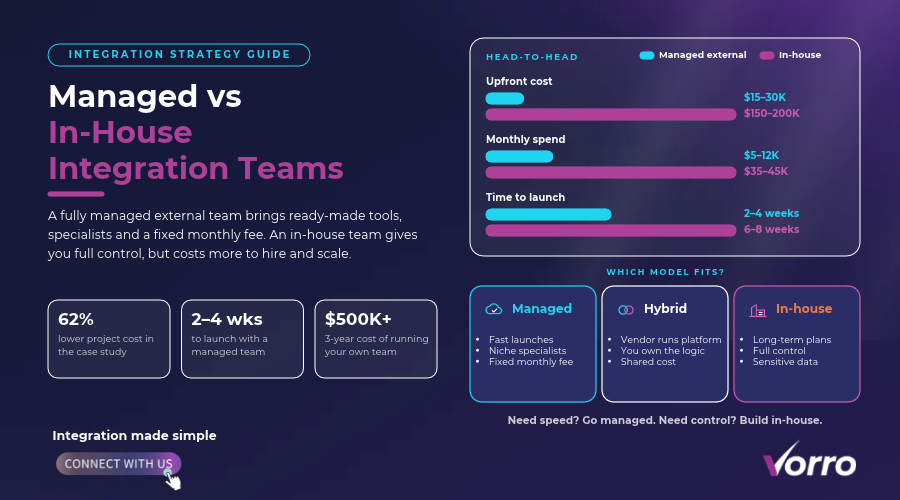
Vorro’s managed services solution helps bring clearer visibility to these and many other facets of your business. It will allow you to be proactive with your organization’s valuable data assets and offers the ability to measure and gain valuable insight for future decision-making. Get the capabilities, insight, and understanding you need to take your business to the next level. Be proactive with your data. Put it to work for you. Schedule a call today. Check out our website, which features a free e-book and much more.
Frequently Asked Questions
How does Vorro give businesses a competitive edge?
Vorro eliminates data silos through intelligent integration and real-time interoperability, enabling faster decisions, lower operational costs, and scalable workflows — outpacing legacy platforms like Mirth Connect, Rhapsody, and Cloverleaf for healthcare and enterprise teams.
What makes Vorro different from Redox, Boomi, or Datavant?
Vorro unifies no-code data pipeline orchestration with native HL7 and FHIR support in one platform, reducing implementation time and cost compared to Redox, Boomi, or Datavant, which often require heavy configuration or third-party consultants.
Does Vorro support HL7 and FHIR interoperability standards?
Yes. Vorro natively handles HL7 v2, HL7 v3, FHIR R4, and EDI standards, enabling secure data exchange between EHRs, payers, and external systems without custom middleware or prolonged development cycles.
How fast can Vorro integrations be deployed?
Vorro integrations typically go live in days to weeks — significantly faster than traditional integration engines — giving organizations an immediate operational and competitive advantage without lengthy implementation timelines.
What industries and use cases is Vorro best suited for?
Vorro is purpose-built for healthcare organizations, health tech vendors, and data-driven enterprises needing secure, scalable interoperability and workflow automation to improve outcomes, reduce manual effort, and accelerate time-to-insight.